
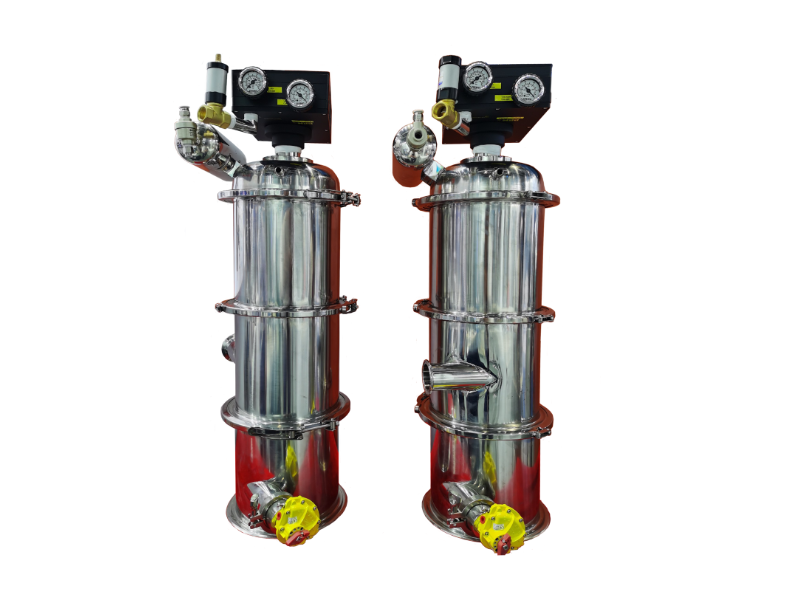
Vacuum Feeder for Granular Materials
Vacuum Feeder for Granular Materials
The vacuum feeder for granular materials uses sealed pipeline conveying, which eliminates dust pollution, improves the working environment, and reduces contamination of materials by the environment and personnel, thereby enhancing cleanliness. Since it relies on pipeline transportation, it occupies little space and can convey powders even in narrow areas, making the workshop environment neat and aesthetically pleasing.
Product Introduction
Equipment Advantages
The vacuum feeder for granular materials uses sealed pipeline conveying, which eliminates dust pollution, improves the working environment, and reduces contamination of materials by the environment and personnel, thereby enhancing cleanliness.
Since it relies on pipeline transportation, it occupies little space and can convey powders even in narrow areas, making the workshop environment neat and aesthetically pleasing.
It is also not limited by long or short distances. Additionally, the vacuum feeder reduces manual labor intensity and improves work efficiency — making it an excellent choice for most powder material conveying methods.
Product Structure of Vacuum Feeder for Granular Materials
The vacuum feeder mainly consists of three parts:
1.Vacuum Power Unit:Common vacuum power sources include
Roots vacuum pump
Turbine vacuum pump
Vacuum generator
Water ring vacuum pump
The main function is to provide sufficient vacuum negative pressure airflow.
2.Gas–Material Separation Unit (Main Machine)
There are two main types:
Continuous vacuum feeder
Intermittent vacuum feeder
Currently, the market trend favors continuous vacuum feeders, especially those designed for long-distance and high-capacity conveying — and this will remain the mainstream direction.
3.Control System
The control system mainly has two types:
Microcontroller (simple system): limited functions and programming options, suitable for basic working conditions.
PLC control: widely applicable and allows customized programming based on site conditions.
Common Faults of Vacuum Feeders:
1.Low vacuum and no suction
First, check the pipeline and equipment connections to see if any clamps are loose and causing air leakage.
2.Remove the inlet of the vacuum pump and check whether the pump is functioning normally.3.Material blockage
Check for blockages in the pipeline or filter element using a sectional inspection method.
The gas–solid mixing ratio in vacuum feeding is a key parameter in pneumatic conveying. It represents the ratio of powder mass to air mass passing through the conveying pipe section per unit time. Increasing the mixing ratio can enhance conveying capacity and reduce energy consumption. However, if the ratio is too high under the same conveying speed, it may cause blockages and require higher conveying pressure. Therefore, during design, factors such as material properties, conveying method, and operating conditions should be comprehensively considered to select an appropriate mixing ratio.
The scope, design, and installation of pneumatic conveying systems are complex and involve many variables. If any link is improperly designed or executed, it may increase operating costs and affect system reliability. We have extensive experience in helping customers design pneumatic conveying systems. Follow us to learn more and design a conveying solution that suits your needs.
Tags:
Flowing: