
Low Starch Screening Efficiency? How to Select a Food-Grade Centrifugal Sieve
Starch is a basic raw material in the food industry, and its production is essential for products such as flour-based foods, snack foods, and seasoning sauces. Screening accuracy directly affects the particle size uniformity of finished products and their subsequent applications.
However, fine starch has a small particle size and low specific gravity, making it prone to agglomeration during screening. Some materials may also generate static electricity and adhere to the back of the screen, causing the mesh openings to become blocked and affecting material passage and screening efficiency. For lightweight, fine, and easily agglomerated powders, conventional screening methods can encounter problems such as declining efficiency and frequent screen cleaning during continuous production, making this a key stage that needs to be addressed to improve production line efficiency.
For fine powders that are lightweight, easily agglomerated, and prone to screen blockage, the centrifugal sieve provides a screening approach different from that of conventional vibrating screens. How exactly does it address these issues in starch screening? This article breaks down the process from the perspectives of operating principle, production line implementation, and equipment selection.
I. Key Challenges: Where Exactly Does Starch Screening Get Stuck?
The core challenge in fine starch screening is essentially the compatibility between material characteristics and the screening method. Starch has a relatively fine particle size, and the material is prone to agglomeration during screening. Some fine powders may also adhere to the back of the screen, causing the mesh openings to become blocked. When the effective open area of the screen decreases, material passage through the screen is also affected, requiring timely screen cleaning.
Starch is a common powder in food production, and there are corresponding requirements for equipment contact materials and material cleanliness. If screening equipment is designed for lightweight, easily agglomerated powders that are prone to screen blockage, it needs to take into consideration several stages, including material conveying, dispersion, screening, and screen cleaning.
On an actual production line, if the screening process is frequently affected by screen blockage, both production efficiency and screening stability will be affected. For starch production processes requiring continuous fine classification, ensuring that materials enter the screen smoothly and maintain effective passage through the screen is an important consideration when selecting equipment.
II. Principle Breakdown: How Does a Centrifugal Sieve Address These Challenges?
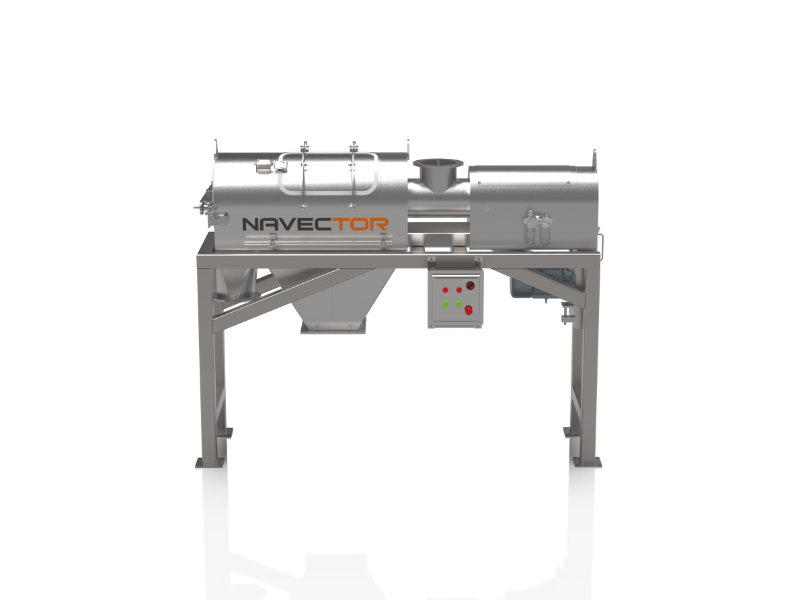
The core operating principle of a centrifugal sieve is to use airflow to drive particle separation while completing screening through a cylindrical screen. Unlike conventional vibrating screens, which rely on screen surface vibration to move materials, the material first passes through a screw conveying system where it is mixed and atomized with airflow before entering the screen cylinder. The fan blades inside the screen cylinder then subject the material simultaneously to centrifugal force and cyclone propulsion, causing it to pass through the screen.
Fine materials that pass through the screen are discharged through the fine material outlet, while materials that cannot pass through the screen move along the cylinder wall and are discharged through the coarse material outlet. For relatively lightweight and fine powders such as starch, this combination of airflow-driven movement and centrifugal separation allows the material to continuously move inside the screen cylinder and complete classification.
For materials that are prone to agglomeration and screen blockage, the equipment can also be equipped with an ultrasonic system to enhance screen cleaning and improve the processing of difficult-to-screen materials. At the same time, the external transducer does not directly contact the material, which can reduce material contamination caused by the transducer during screening. The equipment also has the ability to further break down agglomerated materials, providing a certain level of adaptability to powders with agglomeration and caking issues.
III. Production Line Implementation: What Should Be Considered for the Screen, Material, and Mass Production?
The first consideration is screen selection. The actual screening requirements for starch need to be determined based on the target particle size, material condition, and downstream application. Screen specifications cannot be determined solely based on the material name. Conducting screening tests with actual materials before equipment selection makes it easier to determine whether the screen specifications and equipment operating conditions are compatible.
The second consideration is material condition. If fine starch experiences agglomeration or screen adhesion during screening, particular attention should be paid to the movement of the material inside the screen cylinder and the effectiveness of screen cleaning. For difficult-to-screen materials, an ultrasonic system can be considered according to the actual operating conditions to enhance screen cleaning.
The third consideration is the requirements for equipment contact materials and cleanliness in the food industry. The material-contacting parts of the NCF series centrifugal sieve need to be configured according to specific food production requirements. During equipment selection, material characteristics, equipment materials, and actual production conditions should be evaluated together rather than focusing solely on screening efficiency.
For continuous production applications, actual processing capacity and screen usage also need to be considered. As a component directly involved in classification, the condition of the screen affects screening performance, so it should be inspected and maintained according to actual operating conditions during production.
IV. Selection Decisions: How Should the Equipment and Supplier Be Selected?
First, priority should be given to suppliers that can provide screening tests. Beforehand, actual starch materials used in production should be tested to observe screening performance, material passage, and screen blockage, and then the equipment configuration can be determined. This helps avoid mismatches between equipment parameters and actual material conditions.
Second, the screen is an important component of a centrifugal sieve, and its specifications need to be matched to the actual particle size requirements. For starch powders that are prone to screen blockage, particular attention should also be paid to the equipment’s screen cleaning capability, with an ultrasonic system configured when necessary.
Third, production capacity planning should be determined according to actual production requirements. The processing capacity of a centrifugal sieve is affected by factors such as material characteristics, screening requirements, and equipment specifications, so actual capacity cannot be judged solely based on theoretical parameters.
Fourth, the supplier’s screening testing and technical service capabilities are also worth considering. For powders such as fine starch that are prone to agglomeration and screen blockage, a complete screening verification process, from material testing and equipment selection to specific operating condition matching, can help production companies determine the equipment configuration more accurately.
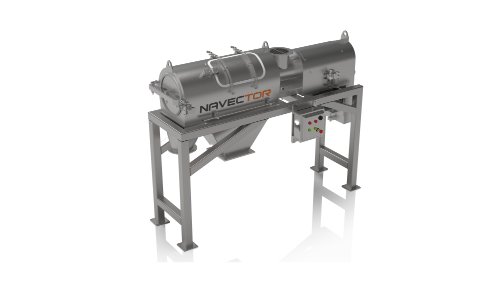
The challenges of fine starch screening are often concentrated around the material condition and screen condition. When materials are prone to agglomeration and screens are prone to blockage, the operating efficiency of conventional screening methods can be affected. A centrifugal sieve completes screening through screw conveying, airflow mixing and atomization, combined with the centrifugal force and cyclone propulsion generated by the fan blades. For difficult-to-screen materials, an ultrasonic system can also be configured to enhance screen cleaning, while the external transducer helps reduce material contamination. This structural design provides a targeted equipment solution for the rapid screening of relatively lightweight and fine powders in the food industry.
For starch producers, selecting screening equipment should not be based solely on mesh size and equipment parameters. Material condition, screen compatibility, screen cleaning capability, and actual test results all need to be considered. Testing the material first and then determining the equipment configuration often makes it easier to identify a screening solution suited to specific production conditions.
Tags:
Flowing: