
How to Choose the Right Sieving Equipment for High-Density Powders? A Source Manufacturer Guides You to Fast Selection
When many customers first reach out, they often ask a simple question: “Our powder is quite heavy—what kind of sieving machine is suitable?”It sounds straightforward, but as a source manufacturer of sieving equipment, we usually don’t provide a quote immediately.
Because selecting equipment for high-density powders is not something you can decide casually. Especially in industries such as lithium battery materials, metal powders, 3D printing, and chemical powders, material density can range from 2.5 g/cm³ to 8.0 g/cm³ or even higher.
Choosing the wrong equipment leads directly to issues such as poor screening efficiency, mesh clogging, a 30%–50% drop in output, a 60% reduction in screen life, and frequent blockages in powder conveying systems. Today, let’s break this down from an engineer’s perspective.
I. What Is Sieving Equipment Suitable for High-Density Powders?
Simply put, high-density powders are not just “heavy-looking.” In engineering terms, they usually refer to powders with a bulk density ≥ 2.0 g/cm³.
Typical materials include:
Iron powder: approx. 3.0–4.5 g/cm³
Copper powder: approx. 4.5–5.5 g/cm³
Tungsten powder: approx. 7.0–9.0 g/cm³
Graphite anode material: approx. 1.8–2.3 g/cm³
Metal 3D printing powder: approx. 4.0–5.0 g/cm³
These materials share common characteristics: high weight per unit volume, large inertia, and complex flow behavior. To put it simply, handling 1 ton/hour of ordinary food powder may be easy, but high-density metal powder behaves like “small steel balls rolling on the screen.” The requirements for sieving equipment are therefore much higher than for conventional powders.
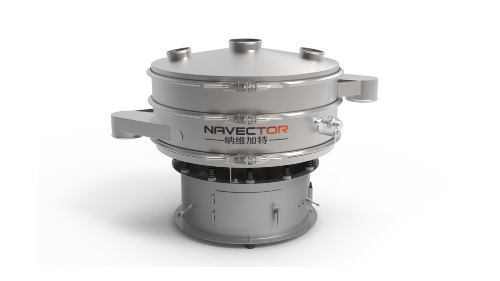
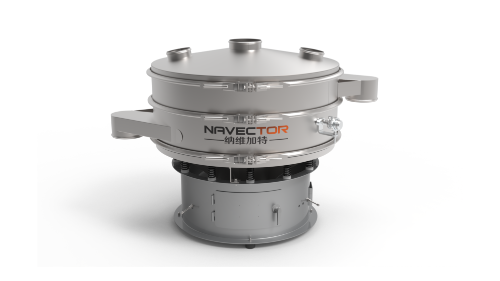
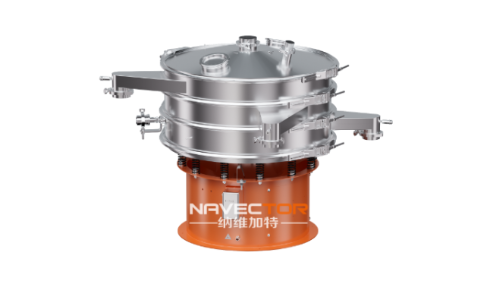
Suitable equipment typically includes ultrasonic vibrating screens, gyratory sifters, direct discharge screens, and integrated powder conveying systems. For fine powders and materials prone to agglomeration, ultrasonic systems should be prioritized.
II. Why Is Selection More Difficult for High-Density Powders?
A real case illustrates this well. A customer producing copper powder for additive manufacturing needed to screen particles in the 45 μm–150 μm range. Initially, they used a standard rotary vibrating screen. The result was very typical: normal operation in the morning, but mesh clogging by the afternoon. Output dropped from 800 kg/h to 420 kg/h.
Why? The core issue: the powder is too “dense.” Engineers usually focus on four key factors:
1.High inertia, difficult to pass through the meshHigh-density powders do not bounce like lighter powders. They tend to press onto the screen surface, especially below 100 μm. If the vibration amplitude is insufficient, particles simply cannot pass through.
2.Prone to agglomerationFor example, lithium battery cathode/anode materials and fine metal powders often exist not as single particles but as agglomerates of 3–10 particles. A measured particle size of 50 μm may effectively behave like 180 μm after agglomeration, leading to misjudgment.
3.Severe static issuesEspecially when workshop humidity drops below 40% RH in winter, metal and graphite powders easily adhere to the screen surface. Many users encounter this problem.
4.Fast equipment wearHigh-density powders cause significantly faster wear on screens and conveying pipelines. A standard 304 stainless steel screen may last 6 months with ordinary powders, but only 45–60 days with high-density metal powders. This is not due to poor equipment quality, but the operating conditions.
III. Who Should Pay Special Attention to Equipment Selection?
Several typical industries:
1.Lithium battery material manufacturersSuch as graphite, silicon-carbon anodes, and lithium iron phosphate. These applications require extremely high particle size consistency, typically controlling D50 deviation within ±3 μm.
2.Metal powder users for 3D printingA very typical case. Materials such as titanium powder, aluminum alloy powder, and stainless steel powder often require strict classification, for example:
15–53 μm
53–106 μm
Clear separation is essential.
3.Powder conveying system integratorsMany problems are not caused by the sieving machine itself, but by the mismatch between sieving, vacuum conveying, and dust collection systems. This is often overlooked.
IV. When Is It Necessary to Reevaluate Equipment Selection?
This is critical. If any of the following occur on-site, reevaluation is recommended immediately:
1.Mesh clogging more than twice per shiftUnder stable conditions, an 8-hour shift should not require frequent manual cleaning.
2.Screening efficiency below 95%For high-precision applications, the industry target is typically 95%–99%. Lower values indicate improper selection.
3.Output deviation exceeding 20%For example, a design capacity of 1 ton/hour but actual output of only 700 kg/h usually indicates undersized equipment.
4.Unstable particle size resultsEspecially when there is a large discrepancy between laboratory and production data, often due to unsuitable equipment motion patterns.
V. Where Are High-Density Powder Sieving Systems Used?
Key industries include:
New energy: lithium battery materials, energy storage powders, conductive agents
Metal powders: iron, copper, titanium, nickel-based alloys
Fine chemicals: metal oxides, catalysts, ceramic powders
Additive manufacturing / 3D printing: one of the fastest-growing application areas
VI. How to Choose the Right Sieving Equipment for High-Density Powders?
This is the core part. Engineers typically follow a five-step method:
Step 1: Check densityAsk for two values: true density and bulk density. For example, true density 4.8 g/cm³ and bulk density 2.6 g/cm³. These directly determine vibration parameters.
Step 2: Define the screening objectiveClarify the purpose:
For impurity removal, oversize removal, or equipment protection before conveying, coarse screening is sufficient.
For micron-level classification, particle size control, and product consistency, fine screening is required, with more focus on precision and anti-clogging capability.
Step 3: Evaluate capacityOften overlooked. Laboratory capacity (5 kg/h) and production capacity (2 tons/h) require completely different approaches.
For example, industrial gyratory sifters can reach diameters up to 3000 mm, which is critical for high-capacity, high-density powder processing.
Step 4: Consider integration with conveying systemsMany applications involve complete systems: feeding → conveying → sieving → collection. A system-level evaluation is essential. Otherwise, even with the right sieving machine, conveying blockages will still occur.
Step 5: Work with a source manufacturerAn industry truth: many traders only ask, “How many decks? What mesh size?” A real manufacturer will ask about density, moisture, static conditions, hourly throughput, and installation space. That is professional selection and evaluation.
VII. Common Questions About High-Density Powder Sieving Equipment
Q1: What type of sieving machine is suitable for high-density powders?It depends on particle size and capacity. Coarse screening can use vibrating screens or direct discharge screens, while micron-level classification requires high-precision equipment.
Q2: Why do high-density powders easily clog the mesh?Main reasons include high particle inertia, a high proportion of fine particles, agglomeration, and electrostatic adhesion, especially below 100 μm.
Q3: What are the most important parameters in equipment selection?Four key factors: material density, target particle size, hourly throughput, and whether continuous production is required. These determine equipment type and size.
Q4: Does a drop in output mean the equipment is incorrectly selected?Not necessarily. In addition to the equipment itself, upstream conveying, feed uniformity, and agglomeration state also directly affect screening efficiency.
Q5: What support can a source manufacturer provide?Typically, selection evaluation, operating condition analysis, full-line matching suggestions, and testing solutions to reduce trial-and-error costs.
Final note from an engineer: for high-density powder screening, the most expensive equipment is not always the best—the key is parameter matching. Correct selection can improve production line efficiency by 20%–35%. Wrong selection leads to constant struggles with mesh clogging and reduced output. In many cases, the issue lies not only in the sieving machine, but in the entire powder conveying and process system.
If you are currently working on equipment selection, powder conveying system evaluation, or production line optimization for high-density powders, feel free to discuss your specific operating parameters, such as material density, particle size range, and hourly throughput. We can provide more targeted recommendations based on real application scenarios. Technical consultation / solution discussion: 15601937055.
Tags:
Flowing: