
Selection Guide for Bulk Bag Unloading Machines in the Food Industry: A Systematic Analysis from Material Characteristics to Unloading Conditions
Bulk bags have become a common packaging format for the storage and transportation of food powder raw materials due to their large single-load capacity and high raw material turnover efficiency. However, transferring raw materials from bulk bags into the production line is not as simple as opening the bag outlet. After storage and transportation, some powders may absorb moisture and form lumps or bridging, affecting the unloading speed. Dust generated during material discharge and bag shaking also puts greater pressure on on-site operation and environmental control. Once the unloading process becomes unstable, subsequent processes such as conveying and mixing may also be affected.
Today, bulk bag unloading machines designed for large-bag powder unloading have become commonly used equipment in food powder production lines. How exactly do they address unloading difficulties caused by lumping and bridging, while also balancing unloading efficiency and dust control? Starting from the basic functions of bulk bag unloading machines, this article examines their configuration based on actual operating conditions in food powder processing and further discusses which companies and production processes they are suitable for.
I. Why Do Food Powders Tend to Experience Unstable Unloading?
Whether food powders can be discharged smoothly depends first on the condition of the material itself. During the opening of a bulk bag, if the material has absorbed moisture, lumping and bridging may occur. Powder that could originally fall under gravity may become retained once such blockages form. Even when the bag outlet has been opened, the material may not necessarily discharge smoothly.
Bridging does not only occur inside the bag. After the material enters the storage hopper, unstable unloading conditions may also cause material retention, resulting in intermittent discharge from the upstream process. In continuous production, if raw materials cannot enter subsequent processes steadily, the production rhythm will naturally be affected.
Dust is another factor that needs to be considered. During bulk bag opening and material discharge, dusty materials can easily generate airborne dust. If the unpacking area lacks appropriate dust collection measures, dust may spread into the surrounding environment. For this reason, bulk bag unloading machines can adopt a fully enclosed structure and be equipped with a dedicated dust collector or connected to the on-site dust collection system.
Therefore, bulk bag unloading of food powders ultimately depends on three aspects: whether the material can fall smoothly, whether it is likely to become retained during unloading, and how the dust generated during the process can be controlled. This also means that bulk bag unloading machines should not only consider “how to open the bag,” but should also be configured with appropriate unloading and dust collection structures according to the material condition.
II. How Does a Bulk Bag Unloading Machine Achieve Stable Unloading?
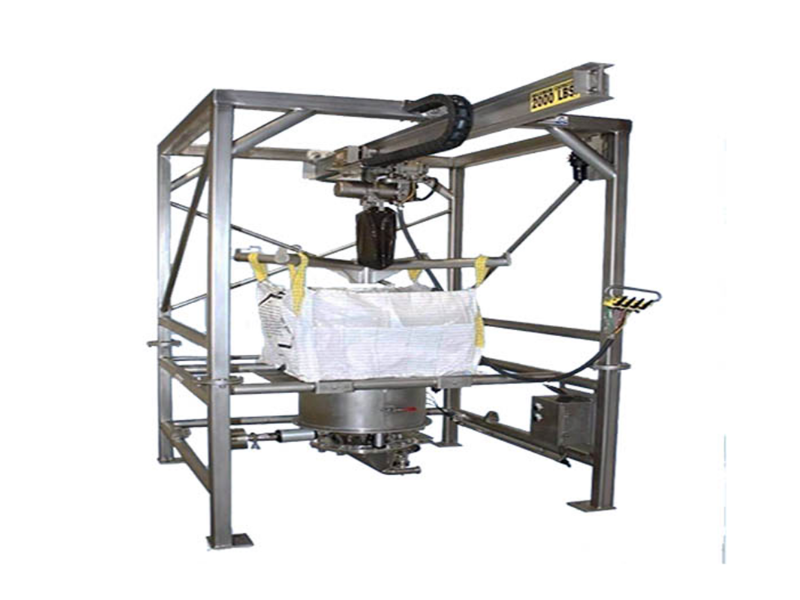
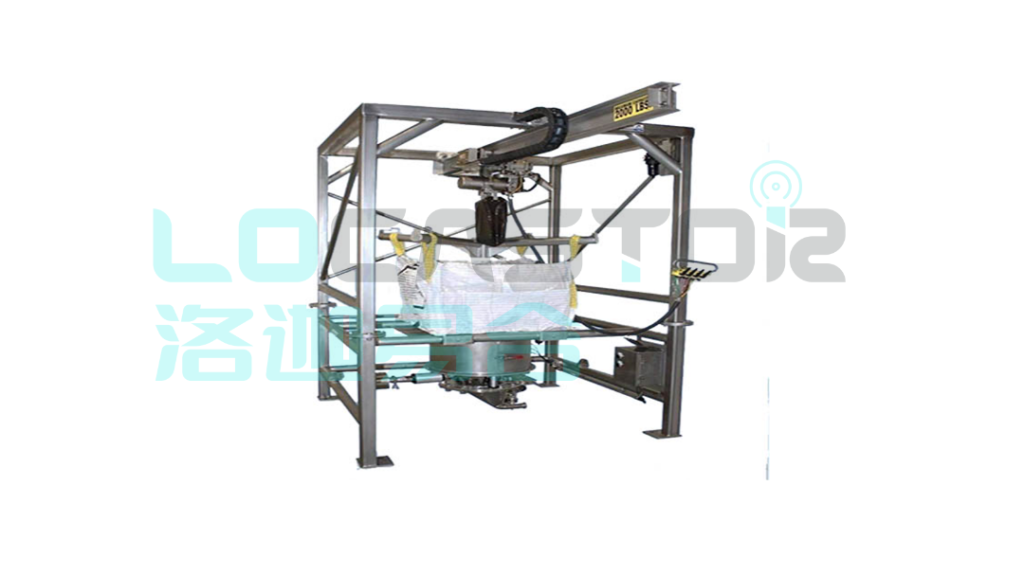
A bulk bag unloading machine is used for unpacking and unloading bagged powder and granular materials. The equipment uses an electric hoist to lift the bulk bag above the machine frame. After slowly lowering it, the discharge outlet can be opened manually, or an optional cross-shaped cutting blade can be used to cut open the bottom of the bag, allowing the material to fall into the storage hopper under gravity.
Gravity is the basis of unloading, but the condition of the material affects whether discharge can proceed smoothly. For powders that tend to form lumps or bridging after absorbing moisture, a tapping device can be installed at the bottom of the equipment to assist material discharge, reduce retention, and improve problems associated with poor bulk bag unloading.
After unpacking is completed, the material still needs to be conveyed to the production line. Therefore, the discharge outlet of the unloading machine can be connected to a screw conveyor, belt conveyor, elevator, or pneumatic conveying system. For materials that are prone to dust generation, a fully enclosed structure can be adopted and equipped with a dedicated dust collector or connected to the on-site dust collection system.
III. How Does a Bulk Bag Unloading Machine Adapt to Actual Operating Conditions?
The configuration of a bulk bag unloading machine cannot be separated from the material condition and on-site process. If the material tends to form lumps or bridging, the unloading process needs to be addressed; if the material tends to generate dust, dust collection needs to be handled; if conveying is required after unpacking, the discharge end needs to be properly connected. Configuration is not about having as many functions as possible. Each function should correspond to an actual operating condition.
1. For materials prone to lumping and bridging, configure a tapping device
For powders that tend to form lumps or bridging after absorbing moisture, a bottom tapping device can be configured. After the bulk bag is opened, the material falls into the storage hopper under gravity, while the tapping device assists material discharge and reduces retention, making unloading smoother.
One boundary needs to be clearly understood here: the tapping device works during the unloading process and is intended to address material retention and poor discharge. It is not equipment designed to crush large lumps.
2. For materials prone to dust generation, configure an enclosed structure and dust collection system
For materials that are prone to dust generation, a fully enclosed structure can be adopted and equipped with a dedicated dust collector, or connected to the on-site dust collection system. Fully enclosed equipment can collect dust simultaneously during operation, reducing dust leakage during bag opening.
3. Match the appropriate conveying equipment according to the downstream process
The discharge outlet of the unloading machine can be connected to a screw conveyor, belt conveyor, elevator, or pneumatic conveying system. When pipeline conveying is required, pneumatic conveying can be used. For conventional transfer of powder between pieces of equipment, a screw conveyor can be used. The specific choice depends on the location of downstream equipment and the production process.
IV. How Can Food Companies Determine Whether They Need a Bulk Bag Unloading Machine?
Whether a bulk bag unloading machine is needed should first be determined by the packaging format, followed by the material condition and on-site unloading method.
For food companies that regularly use bulk bags to package powder and granular raw materials and need to frequently lift, open, and unload bulk bags, a bulk bag unloading machine is more suitable for this type of operating condition. Especially when materials tend to absorb moisture and form lumps or bridging, become retained during unloading, or generate significant amounts of dust during unpacking, the frequency and labor intensity of manual handling will increase accordingly.
Conversely, if the production site mainly uses small bags or drums, a bulk bag unloading machine may not necessarily be suitable. Navector’s dust-free small-bag dumping station is designed for bagged or drum-packaged materials weighing up to 50 kg. The two systems deal with different packaging formats and therefore use different material feeding methods.
Therefore, when determining whether a bulk bag unloading machine is suitable, a practical question can be asked first: How do the raw materials arrive at the factory? If bulk bags have already become the standard packaging format, then by considering whether the material tends to form lumps, whether unloading is smooth, and the dust conditions on site, it becomes possible to further determine whether the equipment needs to be configured.
V. How to Select a Bulk Bag Unloading Machine?
When selecting a bulk bag unloading machine, the equipment itself should not be considered in isolation. Production conditions should first be established. Material characteristics, processing capacity, bulk bag specifications, and the way the equipment connects with the production line are several basic criteria.
Material characteristics determine the unloading configuration, while processing capacity determines the operating rhythm that the equipment needs to match. Bulk bag specifications are related to the lifting and unpacking method. Depending on the site, operators may choose manual bag opening or unpacking with a cross-shaped cutting blade. Navector’s bulk bag unloading machines can be configured according to actual operating conditions.
The next consideration is how the material enters the next process after being discharged. Navector’s bulk bag unloading machines can be connected at the discharge end to screw conveyors, belt conveyors, elevators, and pneumatic conveying equipment. Therefore, selection should take both upstream and downstream equipment into account to avoid disconnecting the unpacking stage from the overall production line. Once these conditions are determined, the specifications and configuration direction of the bulk bag unloading machine become much clearer.
So, returning to the original question: How should the food industry select a bulk bag unloading machine? Bulk bag unloading is not an isolated operation, but a connecting stage through which raw materials enter the production line. Whether the equipment is suitable ultimately depends on the actual problems that need to be solved on site, rather than simply on how many functions the equipment has.
Navector’s bulk bag unloading machines place greater emphasis on configuration according to actual operating conditions. What condition is the material in? How is it packaged in the bulk bag? Where are unloading difficulties likely to occur? How should dust be controlled? How will the material be conveyed afterward? Once these questions are clarified, the direction for equipment configuration becomes clear as well.
Tags:
Flowing: