
Project Overview

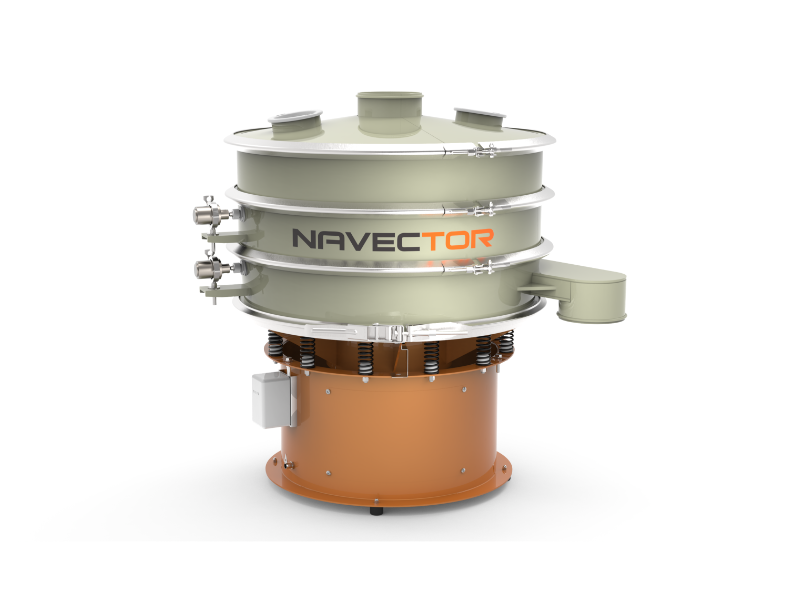
Non-Metallic Screening Machine
【Material Requirements】:Screening and filtration of lithium battery materials, abrasives, chemical powders, pharmaceuticals, powder metallurgy materials, edible powders, electronic materials, and materials with strong acids or strong bases
【Product Overview】:Navector’s Non-Metal Screening Machine is specially designed for screening sensitive powders, particularly for applications requiring zero-metal contamination or prohibition of contact with metallic materials. Its unique structure effectively prevents clogging and particle blinding on 50–625 mesh screens, significantly extending screen life while ensuring continuous production and precise material distribution. The machine can accurately separate fine particles with similar diameters without altering material properties, making it widely suitable for high-demand fields such as advanced new materials.
Principle Introduction
Navector’s Non-Metal Screening Machine is specifically designed for the separation of specialized powders. It can screen and filter a wide range of materials, including heavy or light powders, coarse or fine particles, dry or wet materials, slurries, and liquids. The machine is engineered for powders that must avoid “zero-metal” contamination or contact with metallic materials. Its unique structure effectively prevents clogging and particle blinding on 50–625 mesh screens, significantly extending screen life while ensuring continuous production and precise material distribution. The machine can accurately separate fine particles with similar diameters without altering material properties, making it ideal for high-demand applications such as advanced new materials.
The non-metal screening machine can be equipped with an ultrasonic system, allowing it to screen and filter materials that are corrosive to metals or cannot contact metals, specifically addressing issues such as copper and zinc limits in the lithium battery industry.
The system exhibits excellent compatibility and stable operation, maintaining low operating temperatures for continuous long-term use. When paired with the UCS ultrasonic screening system, no additional cleaning devices are needed, increasing throughput, reducing oversized particles, and delivering technological advantages unmatched by conventional screens.
Equipment Advantages
- Specifically designed for screening sensitive powders, developed to prevent “zero-metal” contamination and avoid contact with metallic materials
- Unique structure effectively prevents clogging and particle blinding on 50–625 mesh screens, significantly extending screen life while ensuring continuous production and precise material distribution
- Precisely separates fine particles with similar diameters without altering material properties, making it ideal for high-demand applications such as advanced new materials
- Equipped with the UCS ultrasonic screening system, eliminating the need for additional cleaning devices while increasing throughput and reducing oversized particles, offering technical advantages unmatched by traditional screens
- Significantly improves screening performance; suitable for powders from 20 μm to 300 μm, particularly effective for difficult-to-screen materials
- Solves screening challenges for highly adsorptive, easily agglomerated, high-static, and low-density materials
- Accelerates the separation of agglomerates, increasing throughput and reducing the proportion of large particles
- Screening capability and range provide technological advantages unattainable by conventional machines
- Excellent system matching ensures stable operation without increasing operating temperature, ideal for materials requiring controlled temperature conditions
Applications
Widely used for screening and filtering in industries such as lithium battery materials, abrasives, chemical powders, pharmaceuticals, powder metallurgy, food powders, electronic materials, and materials with strong acids or strong bases.
Equipment Specifications
| Operating Voltage | AC 220 ± 10% V, 50 Hz |
| Rated Power | 160 W |
| Ultrasonic Output Power | 0–100 W |
| Transducer Resonant Frequency | 38–40 kHz |
Advanced Technology
Trusted for years.
6k+
Successfully Completed
Business Project
25 Years System Warranty
The company has always taken screening technology as its core, focusing on innovative research and development, and has obtained multiple domestic and international certifications.
Our goal
The company intends to strive to occupy a leading position in the specific field of ultrasonic screening and filtering
Technical tenet
Committed to creating a brand-new screening concept, the experience of advanced technology and personalized quality is more important than the screening machine itself
Technological innovation
The company has designed over 400 to 600 types of high-quality products, and Navigart continuously strives to improve and perfect them, ensuring that the products keep evolving