
Project Overview
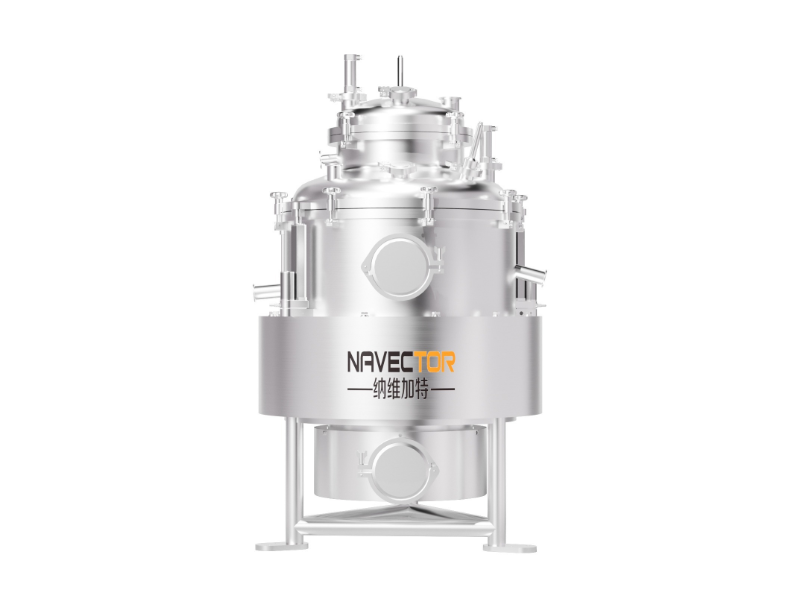
Microsphere Sieve
【Material Requirements】:Used in the biopharmaceutical field for solid–liquid separation of microspheres
【Product Overview】:The Navector Microsphere Sieve is specially designed for medical and cosmetic microsphere screening, integrating filtration, washing, and drying in one system. It separates materials using centrifugal and negative-pressure fluid methods and employs ultrasonic vibration for efficient drying without the need for mechanical stirring. The solids are collected and stored as dry, free-flowing, non-caking powders.
Principle Introduction
In the process of microsphere preparation, vibration screening is a key step in achieving material particle size separation. Through vibration screening, materials with different particle sizes can be effectively separated to ensure that the particle size distribution of microspheres meets quality standards.The power of the vibrating screen comes from the vibration motor.The vibration motor generates a composite inertial force through eccentric blocks of different phases at the upper and lower ends. This force is generated by the high-speed rotation of the vibration motor, forcing the vibrating body of the screening machine to make circular motion.
Equipment Advantages
- On site cleaning
After the production of the equipment is completed, the screen mesh is removed for ultrasonic cleaning, and the interior of the equipment is cleaned comprehensively through the built-in spray ball. The cleaning process fully meets the requirements of ASME-BPE, with no dead corners and full coverage.
After the internal cleaning of the equipment is completed, install the cleaned mesh to prepare for the next step of steam sterilization (SIP).
- on-site steam
After on-site cleaning is completed, all components of the equipment are installed and reset, and online sterilization is carried out through the steam sterilization tube on the feeding port. During the sterilization process, the discharge valve (cylinder body) remains open.
- Vibration drying technology
Nitrogen vibration drying: The vibration generated during equipment operation combines with nitrogen to remove excess moisture from the material, achieving a drying effect.
Control and Efficiency: All drying processes can be adjusted through a control box, making it easy to operate. The drying process is efficient and does not require intermediate transfer or processing steps.
Vacuum and temperature control: Set the indoor vacuum level to medium to optimize drying conditions.
Homogeneous drying process: The material is evenly distributed on the sieve under the action of vibration.
Applications
This product is primarily used in the biopharmaceutical field for solid–liquid separation of microspheres. It allows for batch filtration, washing, dewatering, and drying, all within a sealed system, eliminating the need for intermediate transfer.
Equipment parameters
| Parameter name | PV10 | PV15 | PV20 | Remark | |
| 1 | Working cavity volume | 3.55L | 14.5L | 30.5L | |
| 2 | Material handling capacity | 0.1-0.7KG | 0.5-1.5KG | 1-10Kg | According to particle size distribution and material characteristics |
| 3 | Outer diameter/area of coarse screen | 130mm/130 cm2 | 270mm/572 cm2 | 360mm/1018cm2 | |
| 4 | Outside diameter/area of one screen | 260mm/530cm2 | 470mm/1735cm2 | 610mm/2922cm2 | |
| 5 | Contact material material | 316L | 316L | 316L | |
| 6 | Motor power | 0.25kw/220V | 0.37kw/220V | 2.2kw/380V | Special counterweight tray to adjust the material running track |
| 7 | Motor speed | 1470-2950rpm | 1470-2950rpm | 1470rpm | |
| 8 | Chamber withstand pressure | -0.1—0.3Mpa | -0.1—0.3Mpa | -0.1—0.3Mpa | |
| 9 | Equipment size (L * W * H) | 430*450*800 | 645*480*1200 | 820*795*1250 |
Advanced Technology
Trusted for years.
6k+
Successfully Completed
Business Project
25 Years System Warranty
The company has always taken screening technology as its core, focusing on innovative research and development, and has obtained multiple domestic and international certifications.
Our goal
The company intends to strive to occupy a leading position in the specific field of ultrasonic screening and filtering
Technical tenet
Committed to creating a brand-new screening concept, the experience of advanced technology and personalized quality is more important than the screening machine itself
Technological innovation
The company has designed over 400 to 600 types of high-quality products, and Navigart continuously strives to improve and perfect them, ensuring that the products keep evolving